Promising early results for Belgium’s oyster reef restoration

Researchers from the Institute of Natural Sciences confirm the survival and growth of juvenile European flat oysters introduced in July 2025 as part of the BELREEFS project. The follow up is possible through a smart monitoring programme that allows for rigorous, long-term mapping of reef development. The results of the first monitoring campaign evidence a promising start for Belgium’s offshore restoration of European flat oyster reefs.
In July 2025, more than 200,000 juvenile European flat oysters (Ostrea edulis) were installed on the seabed of the Belgian part of the North Sea, approximately 30 km off the coast at a depth of 30 m. The oysters were seeded onto biodegradable clay bricks, making so-called “spat-on-substrate”, which were then installed at a carefully selected location with natural hard substrate (gravel) within the Natura 2000 area ‘Vlaamse Banken’. European flat oysters are so-called ecosystem engineers: they form reefs that create habitat for countless other species, and as filter feeders they help to keep the water clear. However, due to overfishing and habitat destruction, this important native species almost completely disappeared from our country.
The extensive deployment was part of BELREEFS, the first offshore pilot project which focuses on restoring European flat oyster reefs in Belgian marine waters. The BELREEFS project, commissioned by the Belgian Federal Government (Department for the Marine Environment of the Federal Public Service Health, Food Chain Safety and Environment), brings together expertise from Jan De Nul Group, the Institute of Natural Sciences (Marine Ecology and Management team – MARECO), Shells & Valves and Mantis Consulting. The techniques tested in the project will inform future large-scale restoration efforts, contributing to Belgium’s broader vision for meeting nature restoration targets, particularly within protected Natura 2000 areas.
Smart monitoring
The BELREEFS monitoring team of the Institute of Natural Sciences has developed a thorough plan to monitor the reef development, closely following key metrics developed by the Native Oyster Restoration Alliance (NORA), while adapting protocols to the challenging offshore conditions of the North Sea. This approach will enable BELREEFS to generate data that are comparable across European restoration initiatives. Several of these metrics require retrieving spat-on-substrate for analysis, necessitating a tailored monitoring approach.
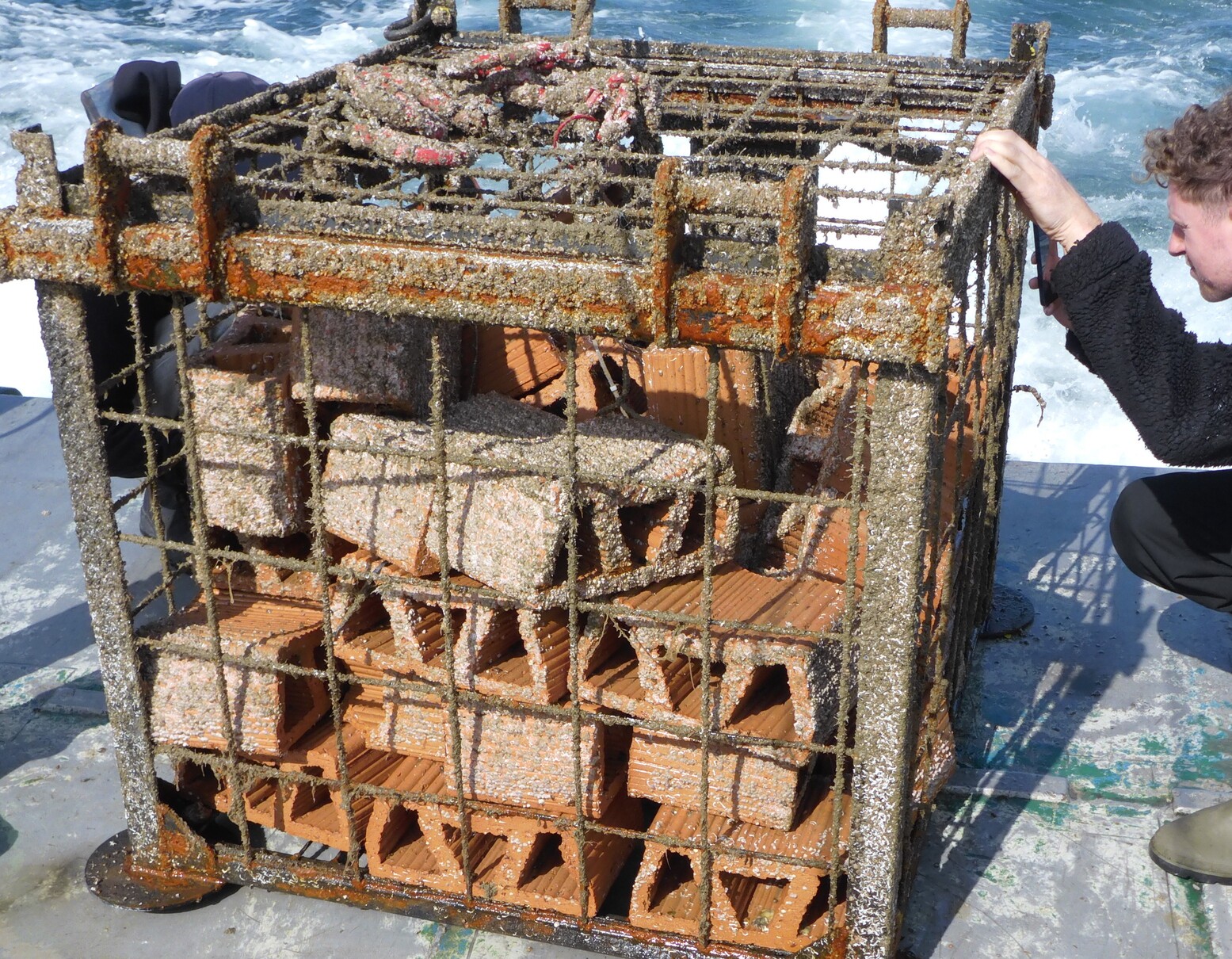
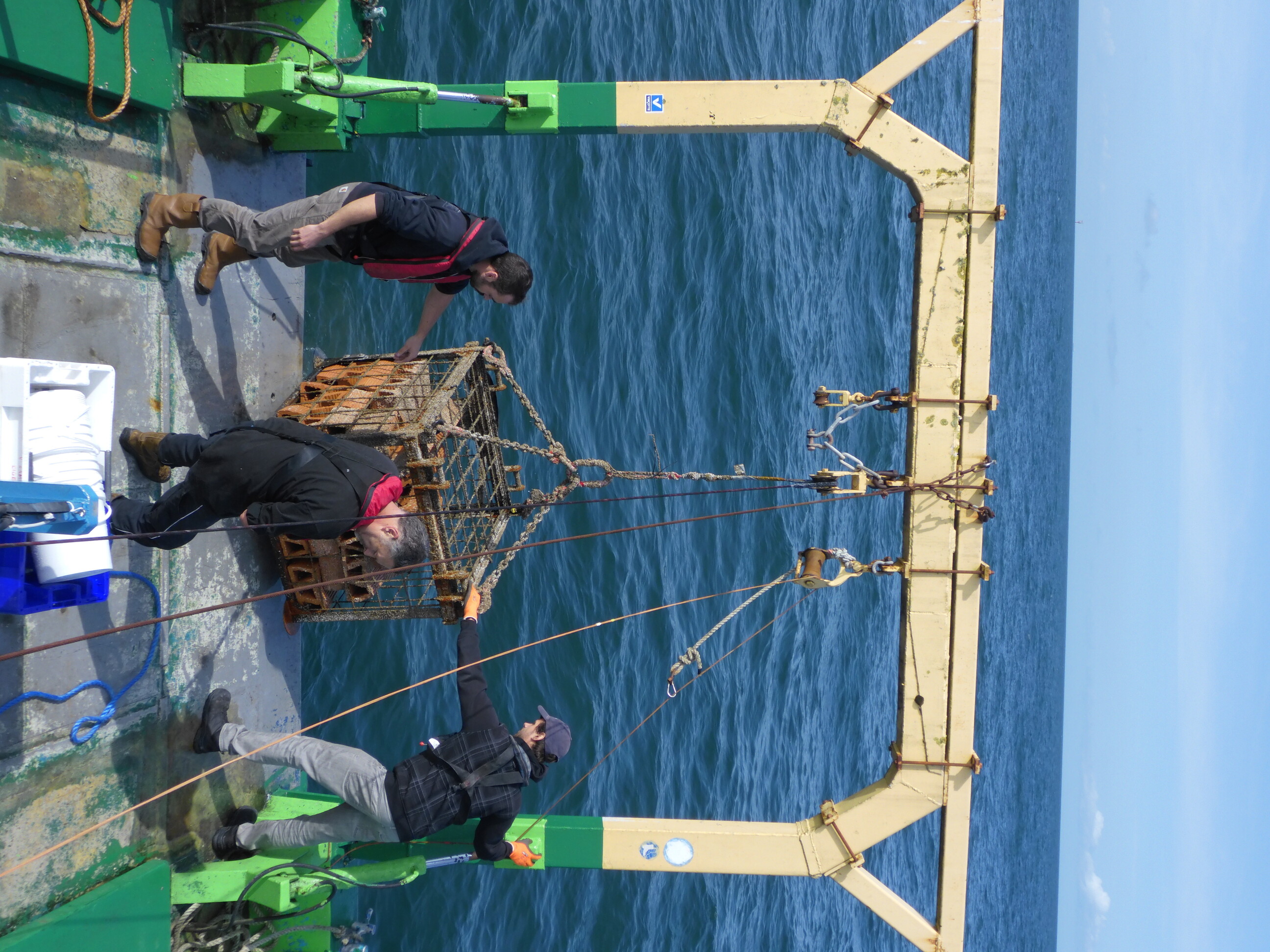
To ensure effective data collection, custom-built monitoring cages were designed by Jan De Nul to enable long-term monitoring in a reliable and standardised manner. Each cage contains a selection of clay bricks, seeded and un-seeded, with wide spaces to allow exposure to the surrounding environment. The cages can be routinely deployed and retrieved either through the integration of an acoustic release mechanism, provided through the activities of the Institute of Natural Sciences within the European Marine Biological Resource Centre Belgium (EMBRC Belgium), or by scientific diving.
First results
With the help of the crew of the STREAM, the first monitoring cage was successfully brought up to the surface in September 2025 using the acoustic release system. On site, the researchers measured oyster survival, growth, density and successfully inspected for new oyster spat settlement. Biodiversity assessments included the identification of sessile and mobile fauna on the substrate, with several smaller and challenging specimens collected for lab identification.
All samples have now been processed. While oyster survival and growth were confirmed, observations also revealed the occurrence of active ecological interactions on the reef substrate. Signs of competition for space and presence of potential predators were noted, and these dynamics will be further investigated during the follow up monitoring phases in the coming years.
“The first monitoring yielded some promising results. We are looking forward to the results of the coming years and hope that the small oysters will grow into a self-sustaining reef, right at the spot where large oyster reefs existed more than a century ago. The fact that we also found colonization by wild oyster spat makes us even more enthusiastic. This is a highly encouraging sign for future restoration efforts.” - Thomas Kerkhove – MARECO, Institute of Natural Sciences
The BELREEFS monitoring programme will continue over the coming years with the retrieval of two more monitoring cages. These long-term observations will provide additional insights into reef development, ecological interactions and overall restoration success in the dynamic offshore conditions. Such information will be crucial for upcoming large-scale restoration plans in the Belgian part of the North Sea, and will further contribute to the shared knowledge gathered over the last decades on flat oyster restoration across Europe.
BELREEFS is a collaboration between Jan De Nul, the Institute of Natural Sciences, Shells & Valves, and Mantis Consulting. It is being carried out on behalf of the Federal Public Service Health, Food Chain Safety and Environment as part of action T4.8 of the LIFE B4B project (101069526).
The oysters were cultivated in collaboration with the Dutch Stichting Zeeschelp and Oyster Heaven (Mother Reef). For all our projects, we collaborate with international experts from the Native Oyster Restoration Alliance (NORA) and follow their guidelines. This allows us to utilize the best available knowledge, advanced technologies, and leading experience.