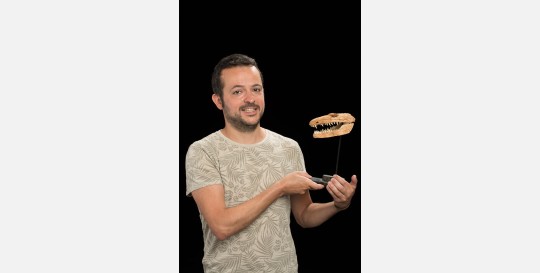
Sébastien Olive

Palaeontologist

Palaeobiosphere Evolution

Earth and History of life

Sébastien Olive


Sébastien Olive is a palaeontologist investigating various aspects of the vertebrate terrestrialisation (land conquest) around 360 million years ago. He uses traditional paleontological methods (description, phylogeny...) together with innovative approaches (CT-scan, geochemistry...) to better understand this key episode of the vertebrate evolution.

Researchgate  Google Scholar ORCID


Function

Currently, Sébastien works as a vertebrate palaeontologist at the Royal Belgian Institute of Natural Sciences (RBINS) and at the Liège University thanks to the FED-tWIN program of Belspo. In this role, and by studying clues of the present and of the past, he focuses on the trophic interactions between aquatic vertebrates both in recent and in deep-time ecosystems. He aims at studying the role of trophic networks in the associated anatomical, physiological and behavioural vertebrate acquisitions. Two periods are of keen interest for him: the vertebrate terrestrialisation episode around 360 million years ago and the ichthyofauna living together with dinosaurs during the Cretaceous period.

Research team: Paleobiosphere Evolution Research Unit
Research theme: Evolution and the Web of Life  &  Ecosystems over time


Current Project(s)

FED-tWIN project 'Evolution of Aquatic vertebrate Trophic networks from the Cambrian to the Present' (EAT) (lead researcher)


Area of Expertise

Sébastien has expertise in various research methodologies, both classic (systematics, phylogeny, anatomical description...) and more innovative (computerized tomography, synchrotron imagery, micro-X-ray fluorescence or calcium and sulphur isotope geochemistry) to better understand anatomy and environments of extinct vertebrates.


External activities

Member of the editorial board of the Journal of the APF (Association Paléontologique Française


Dissemination activities

  • Video on my field trip in Japan
  • Video on my field trip in Bolivia
  • OLIVE, S. 2022. Les poisons de Lompret in Lompret-sur-Mer : Merveilles géologiques de la Fagne (catalogue d’exposition – Musée du Marbre de Rance), NOLIS, K., & HELLEMOND, A. (eds), 40p.
  • CLÉMENT, G., DENAYER, J., GUERIAU, P., OLIVE, S., PERNÈGRE, V. & PRESTIANNI, C. 2022. L’environnement de vie des premiers tétrapodes de Belgique in Paléontologie d’aujourd’hui, CHARBONNIER, S., & DE WEVER, P., K. (eds), edp sciences, Les Ulis (France), 270p.
  • OLIVE, S. 2018. De bouillabaisse van Bernissart. EOS Special Volume « Wie vermoordde de iguanodons ? » 36-41
  • OLIVE, S. 2018. La bouillabaisse de Bernissart. Fossiles H.S. 8 : 57-60
  • DUPRET, V., & OLIVE, S. 2016. Ancient fishes kept their young in a nursery. The Conversation published online November 3rd.
  • OLIVE, S., CLÉMENT, G. 2011. A la recherche des premiers tétrapodes de Russie. Cosinus 130 : 5-9


Professional Experience

Sébastien's professional journey includes various postdoctoral research positions that have enriched his understanding of early and lower vertebrates. Prior to his current role, he completed his PhD here in Belgium at the University of Liège. Then, he worked as a postdoctoral researcher at the Academy of Natural Sciences in Philadelphia (USA), at the Naturalis Biodiversity Center in Leiden (the Netherlands) and at the Ecole Normale Supérieure of Lyon (France) where he developed geochemical skills complementary to his paleontological knowledge.


Publication highlights

GOEDERT, J., BROUSSARD, D., TROP, J., DAESCHLER, E., AMIOT, R., FOUREL F., OLIVE, S., VINÇON-LAUGIER, A., & LECUYER, C. 2025. Oxygen and sulphur stable isotope ratios of Late Devonian vertebrates trace the relative salinity of their aquatic environments. GSA Bulletin 137(1-2): 41-50.

OLIVE, S., PRADEL, A., MARTINEZ-PEREZ, C., JANVIER, P., LAMSDELL, J. C., GUERIAU, P., RABET, N., DURANLEAU-GAGNON, P., CARDENAS, A. L., ZAPATA-RAMIREZ, P. A., & BOTELLA, H. 2019a. New insights into Late Devonian vertebrates and associated fauna from the Cuche Formation (Floresta Massif, Colombia). Journal of Vertebrate Paleontology 39(3): e1620247-1-e1620247-18

OLIVE, S., AHLBERG, P., PERNÈGRE, V., POTY, E., STEURBAUT, E., & CLÉMENT, G. 2016a. New discoveries of tetrapods (ichthyostegid-like and whatcheeriid-like) in the Famennian (Late Devonian) localities of Strud and Becco (Belgium). Palaeontology 59(6): 827-840

OLIVE, S., CLEMENT, G. DAESCHLER, E. B., & DUPRET, V. 2016b. Placoderm assemblage from the tetrapod-bearing locality of Strud (Belgium, Upper Famennian) provides evidence for a fish nursery. Plos One 11(8): e0161540

GARROUSTE, R., CLEMENT, C., NEL, P., ENGEL, M., GRANDCOLAS, P., D’HAESE, C., LAGEBRO, L., DENAYER, J., GUERIAU, P., LAFAITE, P., OLIVE, S., PRESTIANNI, C., & NEL, A. 2012. A complete insect from the Late Devonian period. Nature, 488(7409): 82-85