The Origin of Modern Mammals
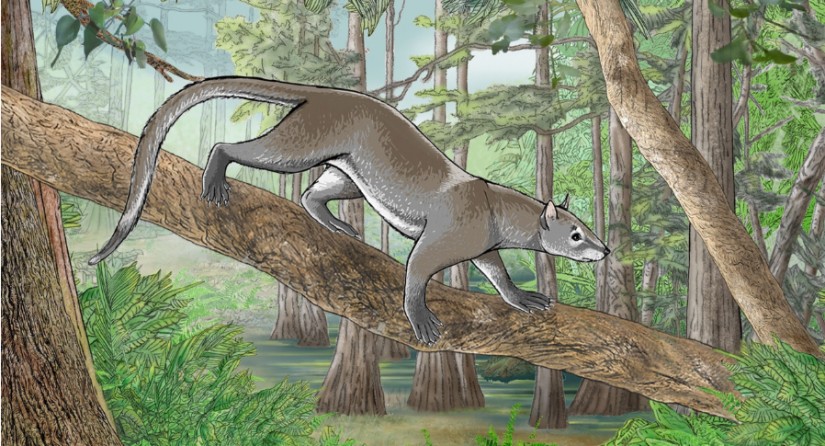
Research conducted over three years by a team of paleontologists from our Institute, in collaboration with 13 other Belgian and French institutes, has led to the discovery of a new fossil mammal site in Rivecourt, in the Paris Basin, as well as a new species of carnivorous mammal in the Belgian site of Dormaal, in Flanders. These studies, published respectively in the international journals PloS ONE and Journal of Vertebrate Paleontology, reshuffle our understanding of the emergence of the first modern mammals, particularly rodents and carnivores.
For several years, Thierry Smith and his collaborators at the IRSNB have been studying the history of mammals. Their research focuses on the Paleogene, the period encompassing the Paleocene (66 to 56 million years ago), Eocene (56 to 33.9 Ma), and Oligocene (33.9 to 23.03 Ma). This period is of particular interest because it corresponds to the so-called “radiation” of mammals: after the extinction of the dinosaurs, mammals diversified and adapted to the lifestyles we recognize today. But how did this happen?
A story in several acts
Paleontologists divide geological epochs based on the fauna and flora found in fossil deposits. The boundaries between epochs are often defined by major extinction events, but others are characterized by the ظهور of new groups. This is the case for the Paleocene–Eocene boundary (56 Ma). This period is particularly fascinating for paleomammalogists because it marks the simultaneous appearance, in Europe, Asia, and North America, of so-called “modern” mammals: rodents, carnivores, primates, artiodactyls, and perissodactyls. These appearances are notably documented thanks to the Belgian site of Dormaal.
However, this is not the only significant event that occurred 56 million years ago. These appearances seem to be linked to a major climatic warming event: the Paleocene–Eocene Thermal Maximum (PETM). It is considered the most intense global warming event experienced by mammals—temperatures, already high at the time, are thought to have risen by 5 to 8°C over a period of 200,000 years.
The recently discovered French locality of Rivecourt is extremely rich in vertebrate remains (mammals, reptiles, birds) as well as plant material (wood, flowers, fruits, seeds). Approximately 500,000 years older than Dormaal, Rivecourt lies just before the Paleocene–Eocene boundary. Comparing these two sites—300 km apart but separated by half a million years—helps scientists understand how “modern” mammals spread across the planet and how climate warming influenced their evolution.
The mammalian fauna of Rivecourt aligns closely with other known Paleocene localities in Europe.
Our paleomammalogists discovered archaic mammal species typical of that era, such as condylarths and plesiadapiforms (now extinct animals). However, the discovery of a rodent incisor—characterized by continuous growth—and a carnivore mandible was more surprising. These findings indicate that “modern” mammals appeared in Europe in two stages: carnivores and rodents arrived at the end of the Paleocene, while primates, perissodactyls, and artiodactyls only appeared a few hundred thousand years later.
While the French and Belgian sites help clarify the history of “modern” mammals in Europe, the question of their origin remains unresolved. The sudden appearance of these early modern species suggests migration into Europe—but from where? From one or multiple regions? These are the kinds of questions paleontologists are currently trying to answer.
When the ancestors of tigers and bears lived in trees
When we think of carnivores, we imagine lions, tigers, bears, and our domestic cats and dogs. But what were they like 56 million years ago? While the Rivecourt site yielded the oldest known carnivore mandible—sharing this distinction with North American fossils—the Dormaal site has produced over 250 teeth, mandibles, and ankle bones (astragalus and calcaneum) belonging to the most primitive carnivore known to date. Most of these fossils were uncovered during excavations carried out in 1989 and 1990 by Richard Smith, one of the IRSNB collaborators.
This small carnivore—estimated to weigh between 500 g and 1 kg and likely feeding on insects and very small vertebrates—is much better understood than its contemporaries. Its teeth have allowed scientists to reconstruct both its adult and milk dentition; the mandibles found at Dormaal indicate that males and females were already differentiated; and the ankle bones show that this animal moved and lived in trees. This is far removed from the carnivores we know today.
The animal was named Dormaalocyon (“the dog of Dormaal”) in honor of its discovery site. But what did Dormaal look like 56 million years ago? As mentioned earlier, the climate was very warm and humid. Forest cover, particularly tropical forests, expanded widely across the Northern Hemisphere—crocodile remains have even been found in Greenland in deposits dating from the early Eocene! This expansion of tropical forests favored arboreal animals, explaining, for example, the presence of small primates at Dormaal—the oldest known in Europe—and allowing Dormaalocyon to migrate from Europe to North America. Among its descendants were the first dog-like carnivores (dogs, bears, etc.).