Belgium launches a national exploration programme for natural hydrogen
The Council of Ministers has approved funding for the national scientific exploration programme for natural hydrogen. With a total budget of €3.5 million from revenues generated by the European emissions trading system, the exploration project aims to determine whether hydrogen is present in the Belgian subsoil. Natural hydrogen offers significant potential for making energy-intensive and chemical industrial processes more sustainable.
Florent Mages
The Belgian Geological Survey (Royal Belgian Institute of Natural Sciences) and BELSPO have jointly developed a national geoscientific research programme for natural hydrogen. This places Belgium among the first European countries to launch a systematic scientific exploration of this resource. With the support of the Ministers of Science Policy and Climate, the Council of Ministers approved funding for this national programme through ETS revenues.
Within Belgian science policy, research is conducted in space, at sea, and also in our own soil. This research programme on natural hydrogen is the result of months of preparatory work by the Institute of Natural Sciences. The uncertain geopolitical context, which obliges us to work towards greater energy autonomy, further underlines the societal importance of such scientific research. By learning more about our subsoil, we can assess whether there is potential for possible future extraction.
Vanessa Matz - Minister of Science Policy
The national geoscientific exploration programme for natural hydrogen
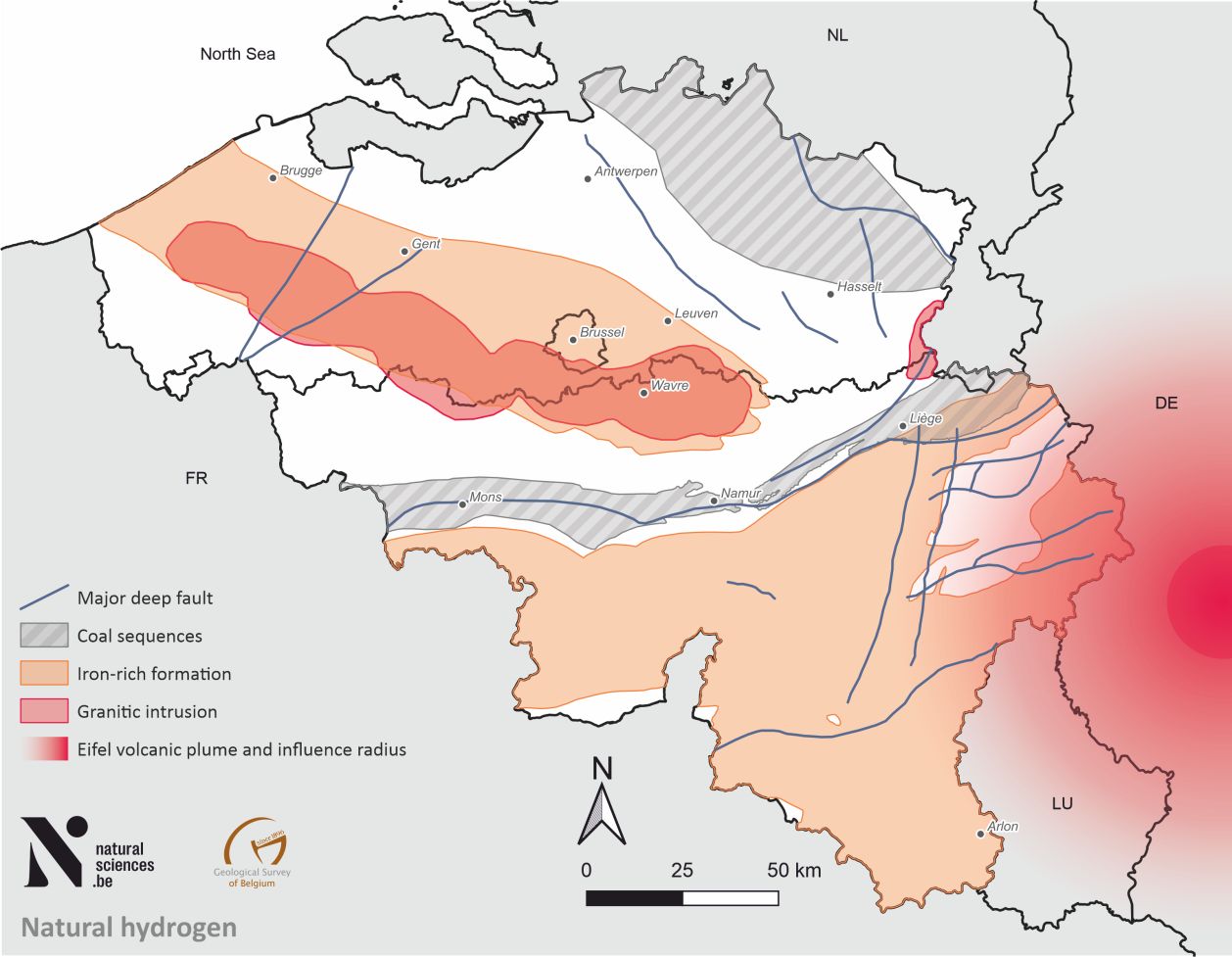
This multi-year programme will map the real potential of natural hydrogen on Belgian territory. The Belgian subsoil has exceptional geological diversity, with several possible hydrogen formation mechanisms (deep degassing, coal basins, oxidation reactions, radiolysis in deep granites). Whether this hydrogen occurs in economically relevant quantities, however, still needs to be demonstrated. The programme aims to fill this knowledge gap and reduce uncertainties, making it possible in time to carry out targeted, well-founded exploration. It consists of two parallel research tracks:
- Geological modelling — "Where is H₂ expected?"
Developing a geological model that integrates the formation and migration mechanisms of hydrogen, incorporating both existing data and new data from field research. The model will extend to greater depths than current geological models for Belgium.
- Field detection — "Where is H₂ detected?"
Building analytical measurement capacities for hydrogen detection and collecting new field data to validate the geological models.
The scientific challenge is clear: to determine, on the basis of objective data, whether the conditions for the formation, migration, and accumulation of natural hydrogen are present in the Belgian subsoil. With this national plan, Belgium is giving itself the means to evaluate this rigorously and at the right scale.
Estelle Petitclerc en Kris Welkenhuysen
geologists Institute of Natural Sciences / Geological Survey of Belgium
The Belgian Geological Survey has already identified deep-lying structures relevant to hydrogen formation. Various zones across the country will be investigated as part of this programme.
Why search for natural hydrogen?
Scientific research into natural hydrogen represents an important strategic opportunity. If geologists establish recoverable volumes on Belgian territory and appropriate extraction techniques are developed, this domestic source of clean hydrogen could be deployed for:
- industrial applications;
- heavy transport;
- optimisation of the energy balance, complementary to seasonal storage.
In a context where the production or import of hydrogen remains costly and dependent on international supply chains, a domestic, low-carbon energy source would represent a significant strategic asset. With this scientific programme, Belgium is giving itself the means to evaluate the potential of a clean and strategic energy source for the future.