Long-snouted crocodilians may have crossed the Atlantic Ocean 80 million years ago, CT scans reveal
30/09/2026
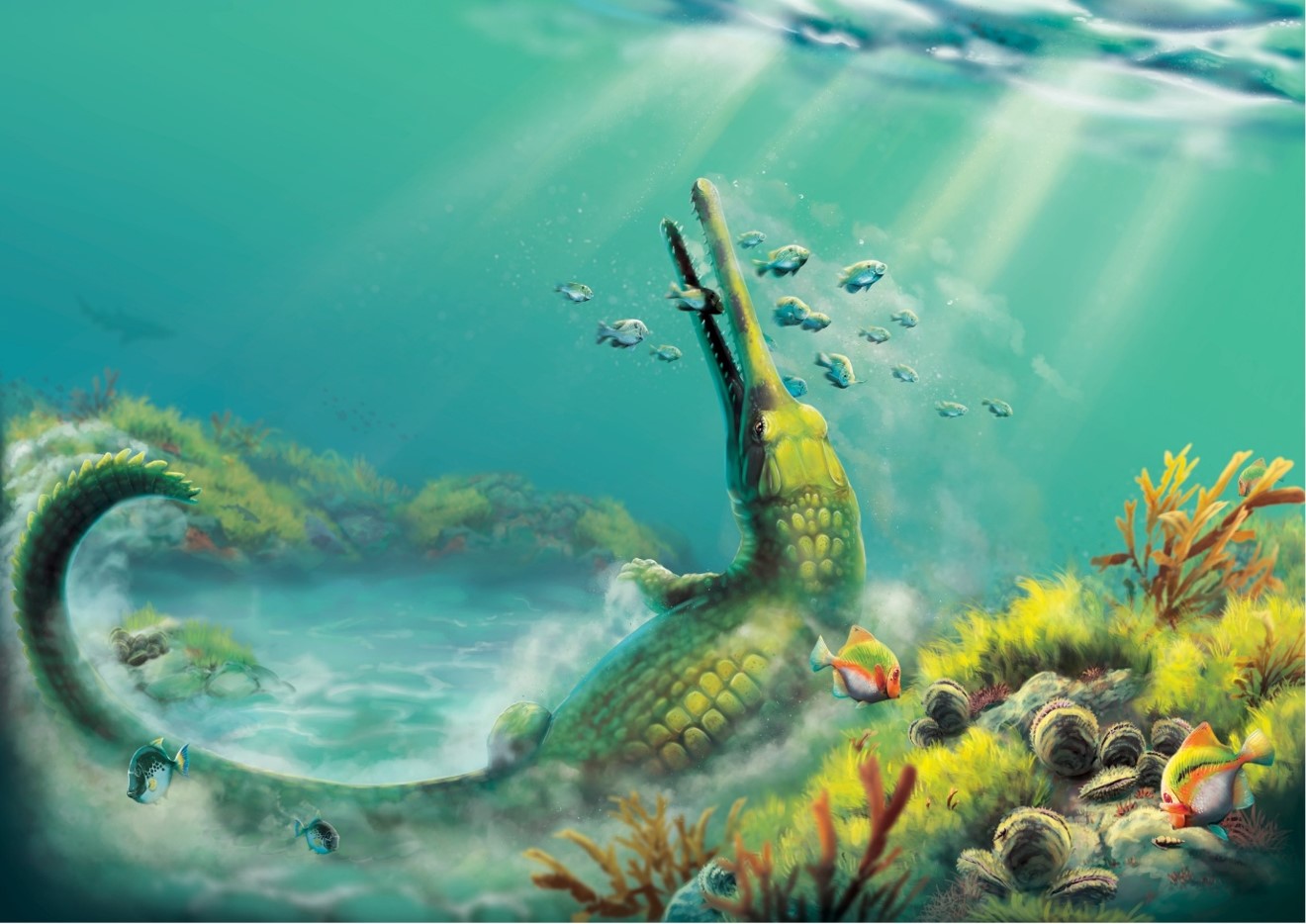
A thoracosaur, with extremely narrow snout. (Artist’s reconstruction by Nathan Dehaut.)
What new insights can a fossil unearthed more than a century ago still provide? Quite a few, according to a new study. A research team led by scientists from KU Leuven and the Institute of Natural Sciences (RBINS) used CT scans to look inside the skulls of fossil crocodilians that lived approximately 80 to 60 million years ago. Inside these skulls, they discovered new clues about how these long-extinct animals lived and how they may even have been able to cross the Atlantic Ocean.
An international team of palaeontologists, led by KU Leuven and the Institute of Natural Sciences, investigated three fossil thoracosaur skulls. Recognisable by their extremely narrow snouts, these animals may have been among the earliest representatives of Crocodylia, the group that includes modern crocodiles, alligators and gharials. Although these fossils have been found more than a century ago, surprisingly little has been understood about these unusual animals until now.
To learn more about these thoracosaurs, the team used CT scanning technology. CT scans of the fossil skulls enabled the team to visualise internal structures concealed within the surrounding bone, in much the same way as hospital CT scanners reveal the interior of the human body. This allowed the researchers to study details of the brain cavity, sinuses, parts of the vascular and nervous systems, and the nasal cavity without damaging the fossils.
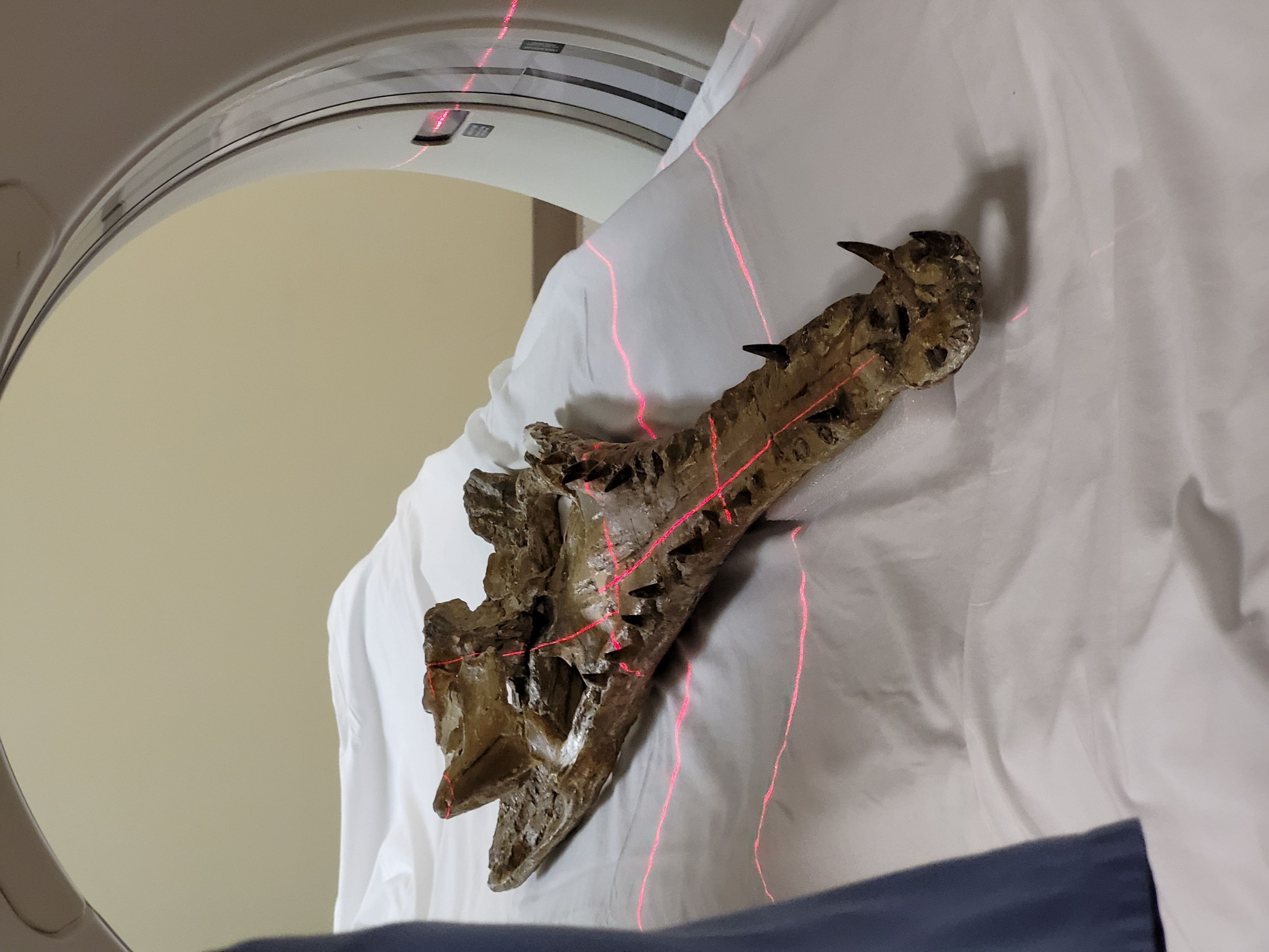
The North-American Eothoracosaurus mississippiensis being scanned at Mississippi State University. (Photo: Mississippi State University)
The fossils examined originated from northern France, southern Sweden and Mississippi in the US, but thoracosaurs were widely distributed in Europe and North America. They lived during a crucial period in Earth's history, between 80 and 60 million years ago, immediately before and after the asteroid impact that brought an end to the dominance of the dinosaurs on land.
Adapted to salt water
The images were a surprise to the researchers. They revealed an unexpected feature of the internal skull anatomy: large, spherical expansions of the nasal cavity located close to the eye socket, structures not found in modern crocodilians. These expansions resemble skull structures seen in other extinct marine reptiles, linked to salt glands. These soft-tissue organs enabled these marine reptiles to remove excess salt from their bodies, allowing them to survive in salty seawater for extended periods of time. The researchers now suspect that the thoracosaurs also had salt glands.
‘Of course, we did not find the salt gland itself preserved in the fossil skull,’ says researcher Sophie Boerman, whose work is funded by the Research Foundation Flanders (FWO). ‘However, the shape and position of these cavities are similar to structures seen in other extinct marine reptiles, suggesting that thoracosaurs were well adapted to a marine lifestyle.‘
This interpretation is supported by the fact that thoracosaur fossils are commonly found in marine rock deposits. The salt glands may also explain why thoracosaurs were found in both Europe and North America: they may have been capable of crossing the Atlantic Ocean. It should be noted, however, that the Atlantic was much smaller 80 million years ago than it is today, and Europe and North America were therefore much closer together.
‘The distribution of these animals is remarkable: we find them both in Europe and North America,’ says Sophie Boerman. ‘The new information obtained from their skulls now provides a possible explanation. If thoracosaurs were indeed well adapted to salt-water environments, this may have helped them disperse across vast marine distances.’
The internal skull anatomy offers further clues about their lifestyle. For example, the inner ear shows characteristics consistent with an aquatic way of life. At the same time, large air passages in the skull suggest that thoracosaurs were probably not deep divers. These structures in the skull may also have played a role in producing or detecting sound underwater, but further research will be needed to test this hypothesis.
The paper was published in the journal Palaeontology.
This article was written by KU Leuven's press office.