Black carbon emissions from ships measured
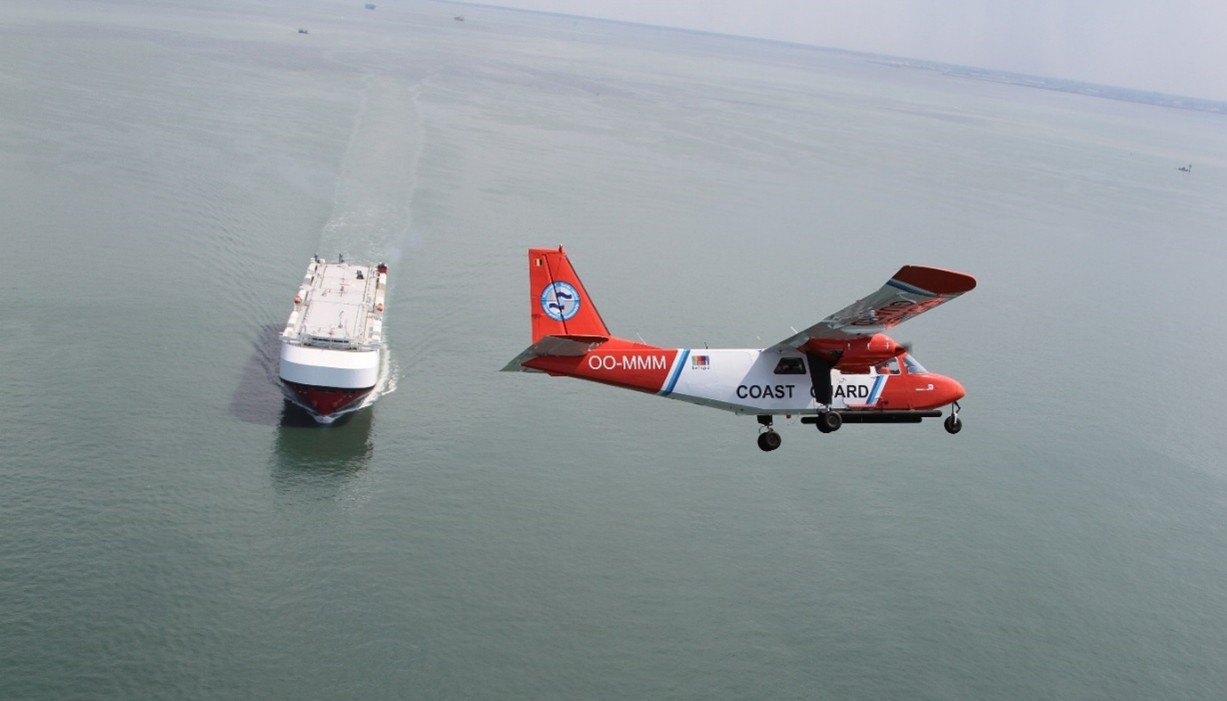
Black carbon emissions from ships in the southern North Sea were surveyed using the sniffer sensor of the Belgian coastguard aircraft. The preliminary results show that these emissions are higher than previously assumed and provide scientific support for the development of international regulations and sustainable maritime policy.
Since 2015, the Belgian coastguard aircraft has been equipped with a sniffer sensor that can measure the concentration of pollutants in emissions from ships at sea. Initially, the system was integrated into the aircraft to monitor and analyse sulfur oxide (SOx) emissions, but over the years it has been expanded to include the ability to detect other pollutants. Since 2020, nitrogen oxides (NOx) have also been measured, and in 2021, black carbon also became part of the air monitoring mission.
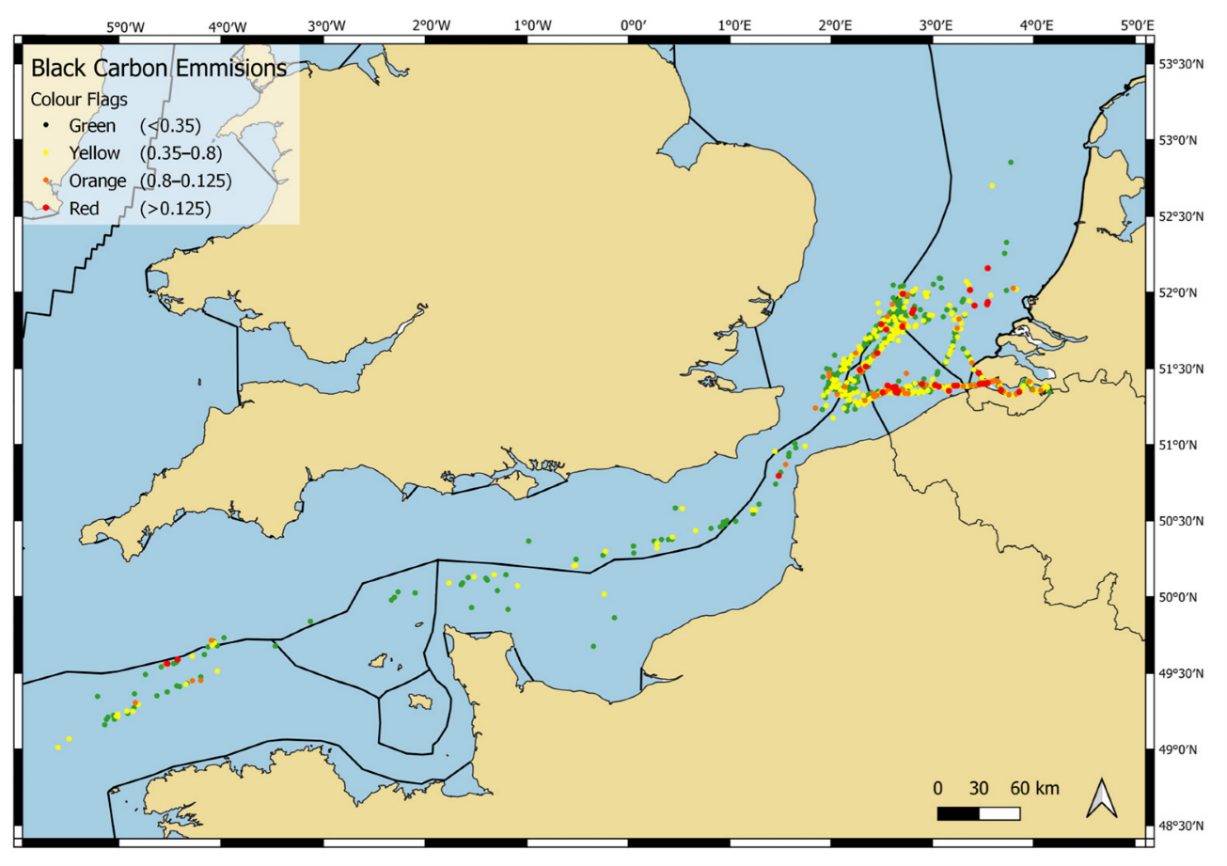
In June 2025, the aerial surveillance team published a scientific article in Atmosphere describing black carbon emissions from maritime traffic in the southern North Sea and the English Channel based on 886 measurements taken between 2021 and 2024. This is the first scientific study of this scale to compile and analyse actual measurements of black carbon from ships. The measurements were taken in the maritime areas of Belgium, the Netherlands, France and the United Kingdom.
What is “black carbon”?
Black carbon is a category of carbon-containing fine particles smaller than 2.5 micrometres (1 micrometre or 1 µm is equal to one thousandth of a millimetre). It mainly comes from the incomplete combustion of carbon-containing fuels such as fossil fuels (like diesel and coal) but also biomass (wood) and biofuels.
As a fine particle, black carbon has an impact on the health of the population exposed to it. Although the exact climate impact of black carbon remains a subject of debate and it is not classified as a greenhouse gas, it is clear that it contributes significantly to climate change. This is partly due to its ability to absorb solar radiation when it settles on polar ice, making it darker.
Interpretation of the results
The long-term research led to a number of conclusions that will be refined in the future with additional data. The main conclusion is that air measurements of black carbon emissions from ships at sea are feasible and that the accompanying observation protocol provides valuable information about the actual extent of these emissions. Until now, such information has been derived from measurements taken under controlled and simulated conditions rather than at sea under real conditions.
The data also suggest that black carbon emissions from ships may have been underestimated. It also appears that ECA-compliant fuels (low-sulphur fuels permitted in the “emission control area” to which the North Sea belongs) contribute to a significant reduction in black carbon emissions. In addition, it also appears that engine load is a determining factor for black carbon emissions.
Science in the service of enhanced sustainability
Black carbon emissions from shipping are not yet regulated, although discussions have been ongoing since 2011 to find the best ways to limit these emissions and their impact. These discussions are taking place within the International Maritime Organisation (IMO), a specialised agency of the United Nations responsible for establishing international rules relating to the safety and security of maritime transport, but also in relation to the prevention of marine and atmospheric pollution by ships.
As a basis for such discussions, the IMO naturally needs robust scientific data, and this is where the new Belgian insights can play a valuable role. Belgium, represented in the IMO by the Directorate-General for Shipping (Federal Public Service Mobility and Transport), brought the research conducted by the Institute for Natural sciences to the attention of the international maritime community here on 21 November 2025. In this way, Belgium aims to raise awareness of the issue of black carbon and provide concrete elements to support the development of effective regulations on black carbon emissions from shipping.
On 26 November 2025, Belgium was also elected as a member of the IMO Council in London, thanks to the ongoing efforts of DG Shipping. The election, formalisation and presentation of Belgian scientific insights to the IMO demonstrate the importance our country attaches to international scientific and political cooperation and its strong support for the transition to a sustainable and less polluting shipping sector.
The coastguard aircraft is owned by the Institute for Natural sciences and is piloted by Defence pilots. The scientific service Management Unit of the Mathematical Model of the North Sea (MUMM) of the Institute of Natural Sciences is responsible for implementing the national programme for aerial surveillance of the North Sea and provides the scientific operators of the aircraft.